Projects

What I am working on right now. Code and papers will follow as each project matures.

Current projectSneak peek

Motion-Conditioned Reinforcement Learning

Julius Samwer
GRILL Lab, Cornell University, project lead · 2026 – present

Motion-conditioned RL specifies a manipulation task by a reference object trajectory taken from a demonstration. A point-cloud policy learns through reinforcement learning to follow that trajectory, here for robotic insertion in simulation.

Using a path-progress reward, we show that the policy recovers from drift off the demonstrated path and, starting from a grasped object, completes about 80% of the reference motion per episode (video).

Next is residual RL on top of a pretrained policy, a step towards goal-conditioned RL for generalist robot policies and compositional skill learning.
ECHO: Emergent Closed-loop Hierarchical Optimization
Work in progressCode on GitHub

ECHO: Emergent Closed-loop Hierarchical Optimization

Julius Samwer
Milstein Summer Research Fellowship, Cornell University · 2026 – present

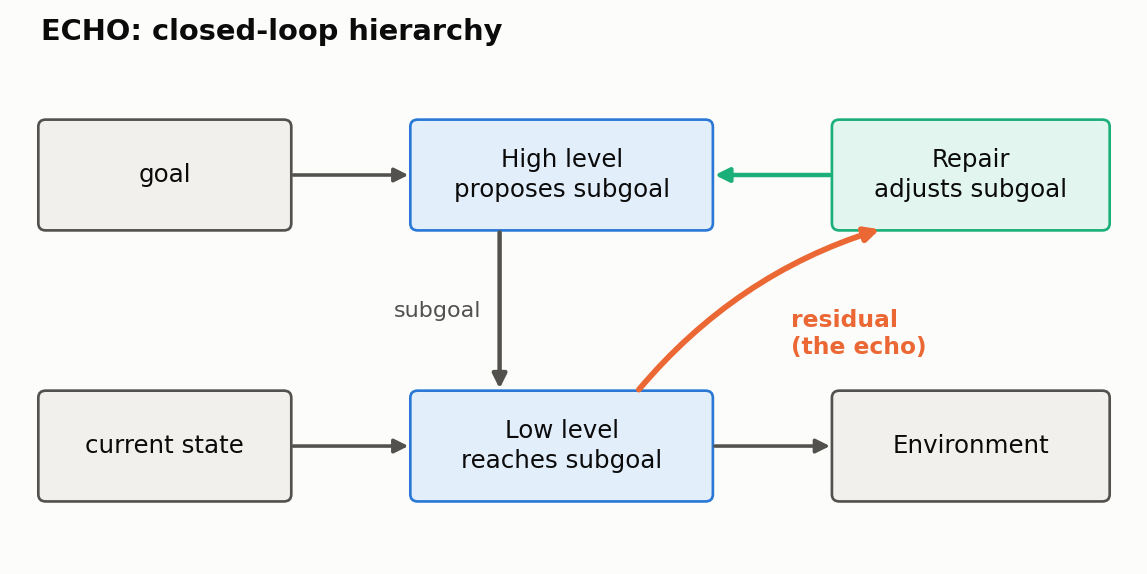
Hierarchical world models (HWM, H-JEPA) plan top-down only: the high level sets a subgoal, the low level chases it, and the high level never learns whether it was reached. ECHO sends the low-level planning residual back up, so the high level can repair subgoals mid-episode (figure).

I reproduced HWM and PLDM on D4RL, found a reachability signal (Spearman ρ = 0.60 between planning residual and execution error), and more than doubled long-horizon success (0.38 → 0.87) in controlled experiments.

CompletedCode coming soon

Simulation Pretraining for Data-Efficient Imitation Learning

Julius Samwer
Milstein Program in Technology & Humanity, junior project · 2026

Imitation learning for robot manipulation typically requires on the order of a hundred teleoperated demonstrations per task, each recorded by hand on physical hardware. This project studies whether pretraining on simulated demonstrations reduces that requirement. A SmolVLA vision-language-action policy is pretrained on 1,000 pick-and-place episodes in an NVIDIA Isaac Lab replica of an SO-101 arm and workspace, with lighting, colors, object position, mass and friction randomized per episode, and then fine-tuned on 5 to 100 real teleoperated demonstrations.

A policy trained only in simulation achieves under 5% success on the real arm. Used as initialization, however, sim pretraining improves success at every data budget tested, with the largest gain in the low-data regime (+20 points at 10 demonstrations). With 25 real demonstrations, the sim-pretrained policy performs comparably to a real-only policy trained on 50.